


Politico’s head of product has explained how the political publisher is moving to one content creation platform and one global app for the first time.
Francesca Barber, the publisher’s executive vice president of product, audience and AI, told Press Gazette that Politico said: “You have to build the plumbing in order to leverage the technology. That’s what we’re doing.”
Politico is also gearing up to launch a global app, which will contain all of its free and paywalled journalism from both the US and Europe for the first time, by the end of the year.
The app will be localised and personalised depending on where the user is, featuring some curation but also the most relevant products such as the London Playbook newsletter or the Brussels Playbook podcast.
Currently, Barber said, Politico staff work across more than six different platforms on the backend. They include platforms to run Politico Pro in Europe, Politico Pro in the US, the politico.eu website, politico.com, a WordPress CMS in Europe, and a Brightspot CMS in the US.
There are also two apps, one for the US and one for Europe, operated by separate teams.
The aim is to be able to publish faster across Politico’s various geographies and platforms. Politico has newsletter and website editions in the US, UK, Brussels (EU), France and Germany, and has newly launched in Australia and is about to go live in Spain.
Further down the line Barber said they are preparing to think about bringing together the .com and .eu websites.
Barber said they have chosen a new headless CMS platform called Sanity, which can be used to build prototypes and apps as well as help “connect dots” between work being submitted by journalists globally.
A headless CMS separates content creation and editing from presentation and outputs. Norway-founded Sanity is now headquartered in California and its publishing clients include Condé Nast, Morning Brew and Semafor.
The first Politico teams started publishing on Sanity this summer and the system is being rolled out across the newsroom over the rest of this year.
Barber said it is helping Politico journalists be more innovative, by “empowering reporters themselves to build their own apps for their own workflows”.
Sanity markets itself as a content operating system rather than a content management system, which Barber said is an important distinction because “you want a system that thinks about content in a dynamic way”.
She said she sees the traditional content management system as an “antiquated” place with negative connotations“where you store things, but it can’t proactively work for you”. Within Politico, they are describing the new system instead as an “authoring tool”.
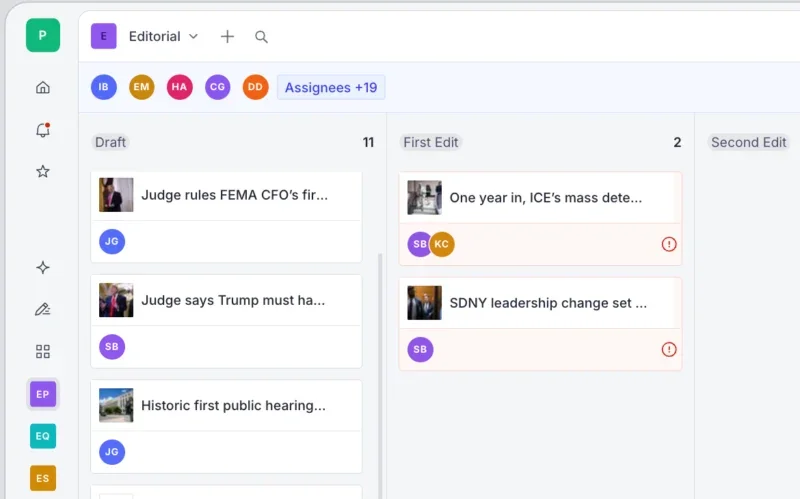
New Politico tech ‘unlocks’ innovation
Barber said the new tech has “unlocked” innovation at Politico, saying a product manager who “can now just build something in Claude and ship it to Sanity”.
Previously, a product build would have taken months, she added.
Barber continued: “From my perspective, if we want to innovate with features on our mobile app, if we want to think about new features, new ways of surfacing our journalism, new formats, you have to think about the CMS that you’re using… You have to have a system that actually can organise and structure your content.”
Before joining Politico in May 2023, Barber spent almost nine years at The New York Times mostly helping to lead its video strategy. She also has tech experience at Google and a San Francisco-based reservations platform for tour operators.
Barber’s first role at Politico was executive director of global newsroom strategy. But, she said, when she arrived she realised the publisher was not yet a unified global operation from a tech perspective.
“There was a Europe Slack channel and a US Slack channel. So even just trying to Slack colleagues… This was just three years ago.” Barber also recalled being unable to see global colleagues’ calendars.
Barber became EVP of AI and innovation in August 2025 and added product to her remit at the start of this year.
That marked the first time Politico had a global product team, she said.
“One of our superpowers of Politico,” Barber said, “is that we are connecting the dots across geographies and across policy lines, while also maintaining that local dominance. And you can’t do that unless you have a really good CMS that can serve different editors or different reporters various pieces of information globally that’s relevant to whatever they are also publishing or putting into the CMS.”
Tech teams brought together into one newsroom innovation hub
In June Politico created a newsroom innovation hub bringing together “newsroom engineering, reporter tools and newsroom platform innovation” under one focused leader, Dani Feldman, as vice president of newsroom innovation and AI.
In a note to staff Barber said the aim was that “the hub will use technology to build workflows that change how our newsroom reports, edits, and publishes stories”.
It is also helping to build proprietary datasets, such as how Politico pulled together more than 20,000 rulings on ICE detention practices in the US and used AI to sift through them. “So that is a moat for the business, and also can live in Sanity,” Barber said, meaning that if someone globally wants to refer back to that data, they can.
The Politico newsroom has been doing regular hackathons using OpenAI tech like Codex (parent company Axel Springer has a partnership with the AI company).
Barber said they are building apps to monitor press releases and legislative data, for example, and that Sanity is now allowing them to launch apps for internal use.
“The reason that’s a big deal… is because you’re then connecting these apps that our reporters are using to the content and information that’s in our CMS,” she said.
Barber said that last year, Politico built a browser extension in Google Chrome that uses its style guide to provide feedback on stories.
“Rather than that being a Chrome extension, which is so clunky, it will now just live within Sanity,” Barber said.
“So it basically enables faster prototyping and app building, and connects it to the journalism.”
The Brussels Playbook team built an event-monitoring tool during a hackathon that pulls together relevant information, checks names and job titles and formats it to match the Politico newsletter structure, cutting out manual assembly work.
Staff also built a headline bot that uses historical data on clickthrough rates on headlines that match the style guide. The bot can suggest different headlines as an article is being written but reporters don’t have to use them.
A tool monitoring keywords in press releases and published articles led to a deep dive into the political divide of hosting the World Cup.
Within Sanity, an internal tool called Speedfeed means Politico journalists will be able to be notified when a colleague in a different country is writing something relevant to their market before it is published.
For example, Politico launched in Australia in August and Barber noted there were “a couple of elements of what we broke that are relevant to teams in Europe, in the US – or even more specifically in Sacramento and in London. So how do we make sure that our content system can proactively say ‘this was just broken. That might be relevant to your story.’ And it integrates with Slack, so you can imagine how powerful that then becomes.”
Barber said they are making sure the journalists can have autonomy in terms of when their reporting is shared with colleagues, so that it only informs the wider teams when they are happy for it to do so.
She added that local teams can put their own twist on a story that originated elsewhere: “Like ‘this happened. This could impact the UK in X Y Z way, or in the UK, this group of people have been discussing it, connected to the US’. So it’s one to go a level deeper and advance a story in whatever local hubs.
“Also, if we can catch it while the thing is being drafted, then you could say this person in the US who was writing on the space data centres, perhaps a colleague in Brussels actually has a little scoop that they were just carrying in their notebook or their mind, and they are like, oh, I actually have something that I can add to that story.
“So we’re really being proactive about how we can connect dots and also supercharge our reporters, so that they feel like they themselves are really well sourced in multiple hubs and bubbles.”
Politico considers ‘tailored approach’ to AI bot scraping
The website replatforming is also leading Politico to think about how best to implement “a tailored approach to bots, depending on the kind of content”, Barber said.
“I am a big believer that we have to protect our IP… I think there is some benefit in learning and experimenting, but not at all-access.”
Barber said Politico is in the process of finalising its approach to AI bots. She added it has been “blocking much more aggressively” in the past year “and we will continue with the exception of some adjustment on some content”.
Barber noted that if they have “really good content tagging” in the CMS, they “should know how many pieces of original information exist on every story… Just because it’s free [to readers] doesn’t mean that it’s free for people to crawl.”
But some commodity information stories, for example Keir Starmer’s resignation as prime minister, may be “fine for us to show up as a brand name” in AI answers and thus allow crawling.
“But as far as I’m aware, no one’s proved a business model from being scraped and then clickthrough.
“Stronger subscribers, I’ve heard – once they click. That’s not sustainable. We’re in the business of building a sustainable business model. So whatever we do has to be sustainable and has to enable us to grow.”
Email pged@pressgazette.co.uk to point out mistakes, provide story tips or send in a letter for publication on our "Letters Page" blog
